
GLOBAL MAP & TYPOLOGY
How are food systems actually governed around the world?
We conducted the first global, systematic mapping of multisectoral food system governance institutions, reviewing all 197 countries to identify where dedicated, cross-sectoral institutions exist — and developed a typology classifying the designs in use.
A growing global movement
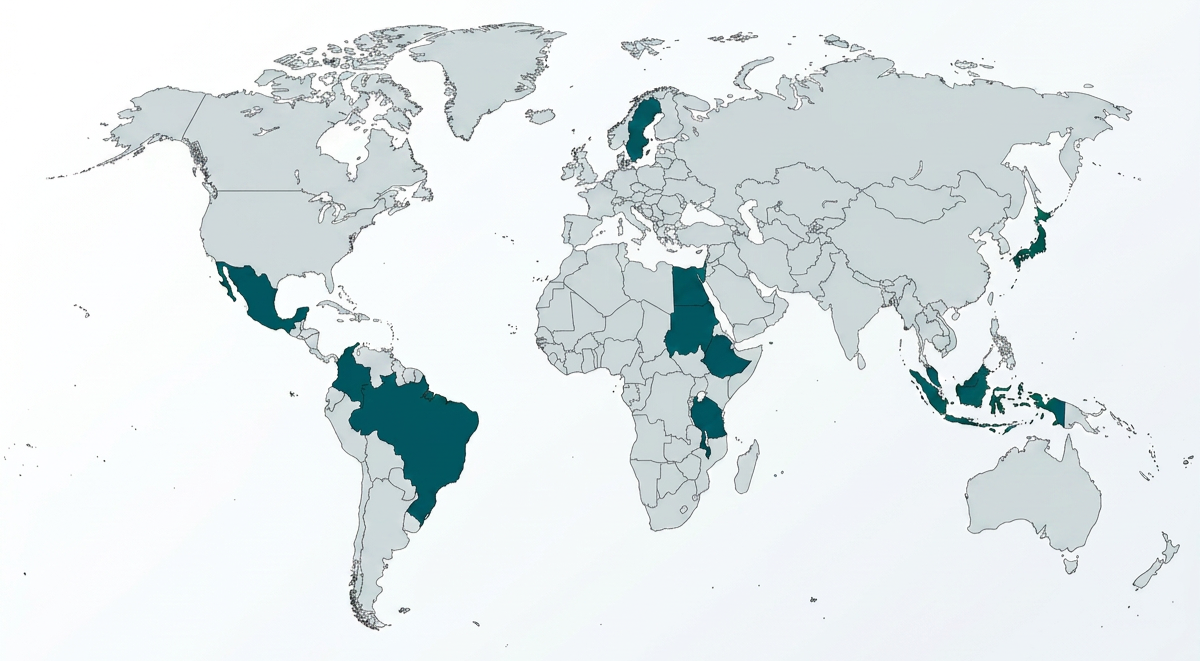
Thirty-five countries — 18% of those reviewed — have an institution that coordinates food system policy across sectors, with the aim of advancing social, environmental, and economic goals together. Eighteen were established after the 2021 UN Food Systems Summit, pointing to a marked rise in multisectoral governance since the Summit.
Countries have taken two main routes. Four established a dedicated ministry or government unit — such as a Ministry of Food — to lead food system coordination. The other thirty-one created governance mechanisms: committees, councils, forums, or working groups that bring ministries and other actors together around a shared table. Of these, ten coordinate within government alone, while twenty are participatory, also involving non-state actors such as civil society, producers, and the private sector — though the depth of that involvement varies considerably.
Most countries built on foundations already in place: at least nineteen adapted or expanded existing arrangements, for example by broadening a ministry's remit or renaming a nutrition unit to take on food system coordination. At least eleven chose to establish entirely new structures following the 2021 Summit.
No single blueprint
The diversity we found makes one thing clear: there is no 'one size fits all' model for food system governance. Local political, social, and economic contexts shape every choice. Rather than prescribing an ideal design, the mapping identifies nine building blocks — the core functions an institution can perform, spanning agenda setting, policy making, implementation, and monitoring and evaluation. Governments can draw on these to 'custom fit' an institution to their needs. No country's institution performed all nine, and more is not necessarily better: additional functions bring added complexity, cost, and a greater need for strong convening authority.
Understanding the typology
The 34 institutions take a wide variety of forms, and the mapping groups them into a typology that helps governments see the range of options available.
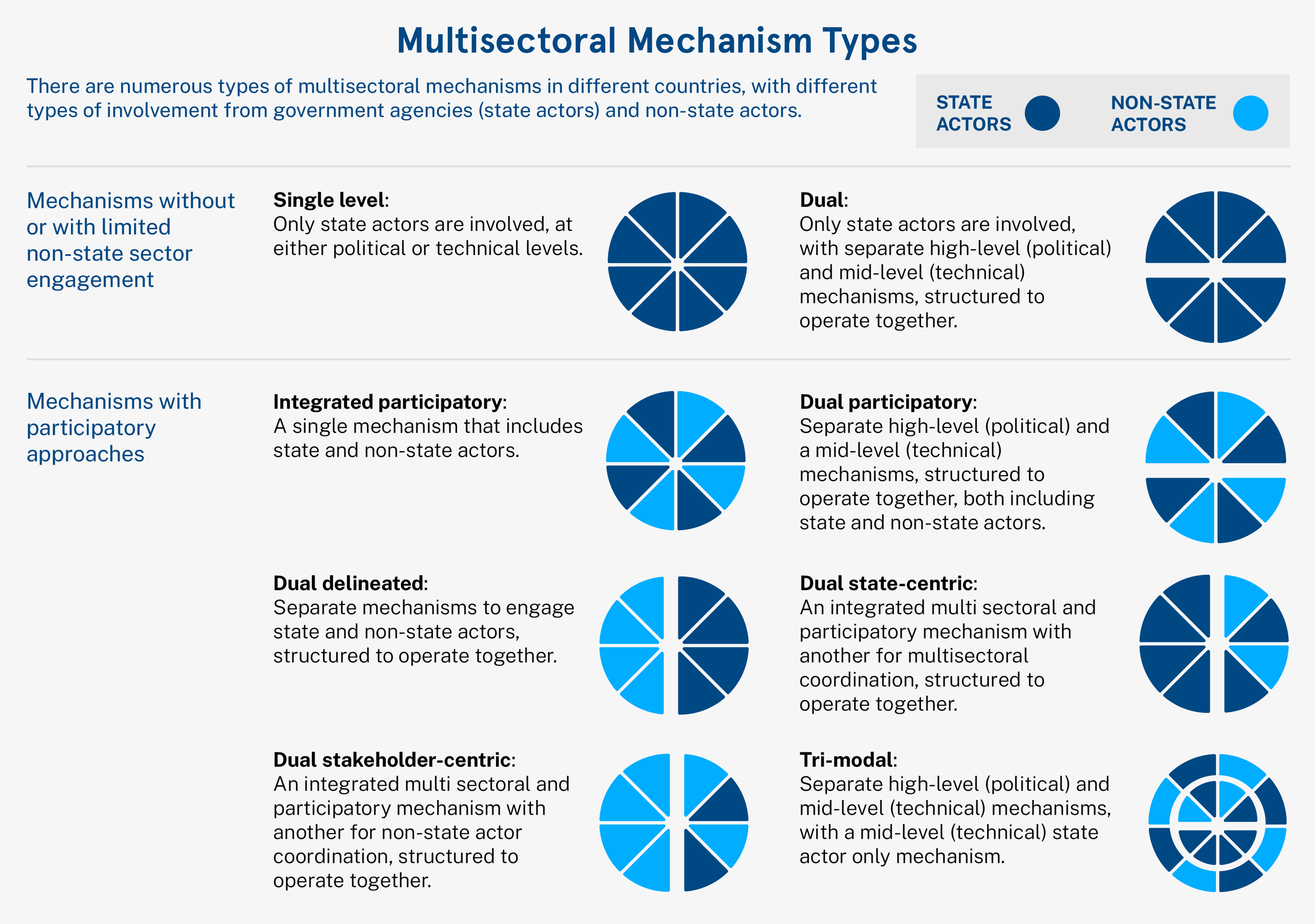
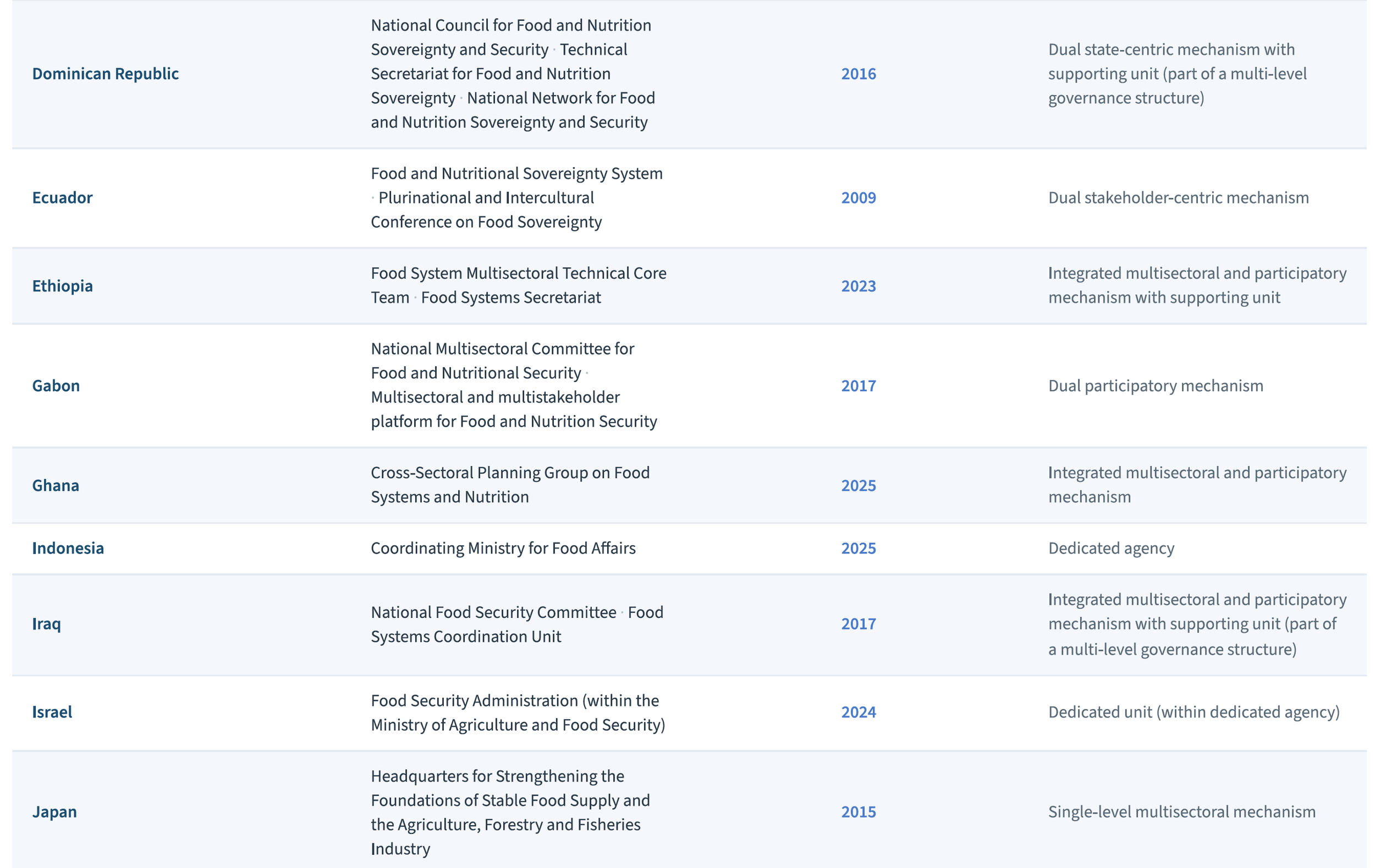
At the broadest level, institutions fall into two families. Four countries established a dedicated ministry or government unit — a stand-alone body such as a Ministry of Food — to lead food system coordination. Thirty countries created governance mechanisms: committees, councils, forums, or working groups providing a platform for formalised interaction and coordination between ministries and other actors.
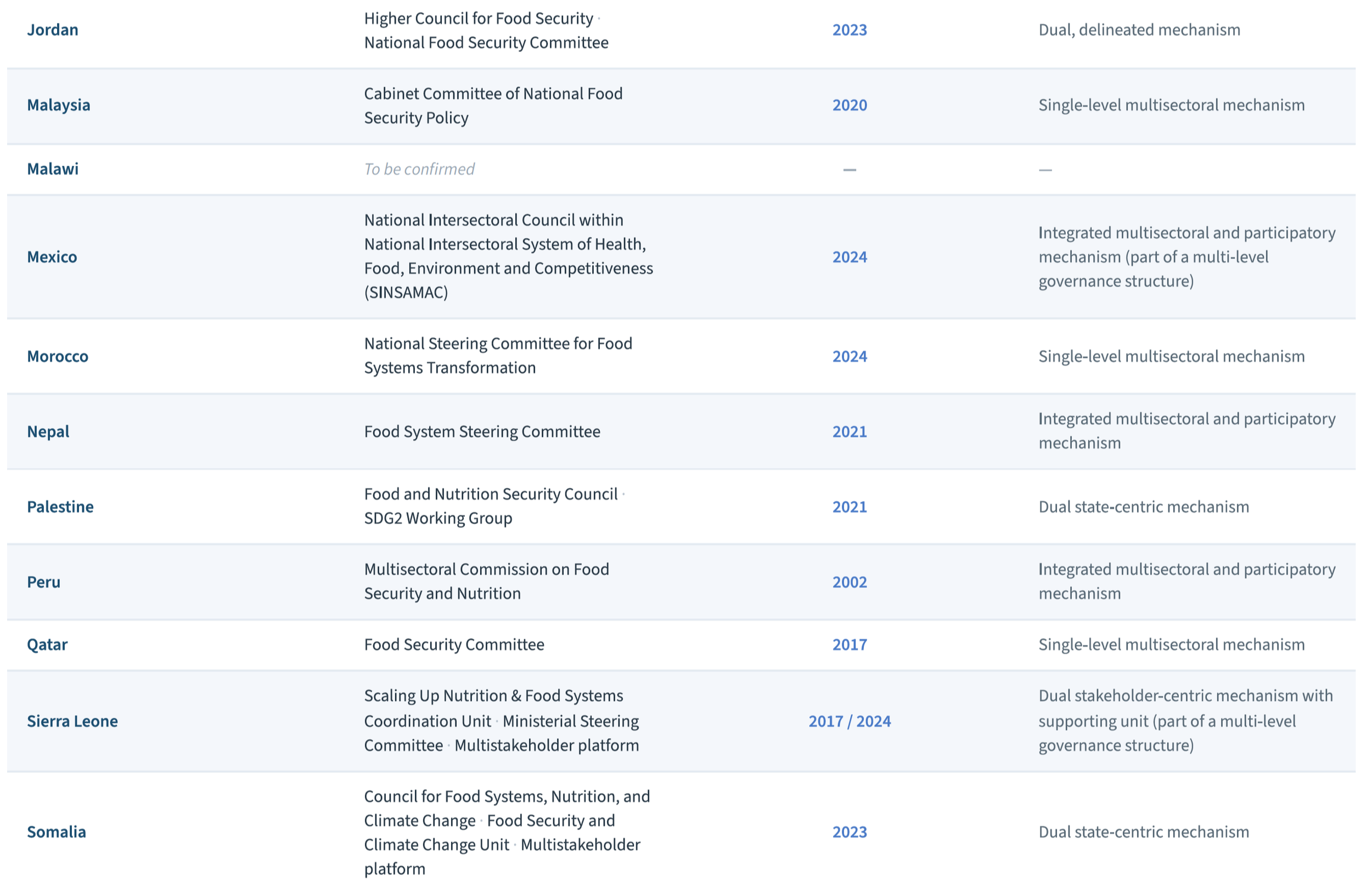
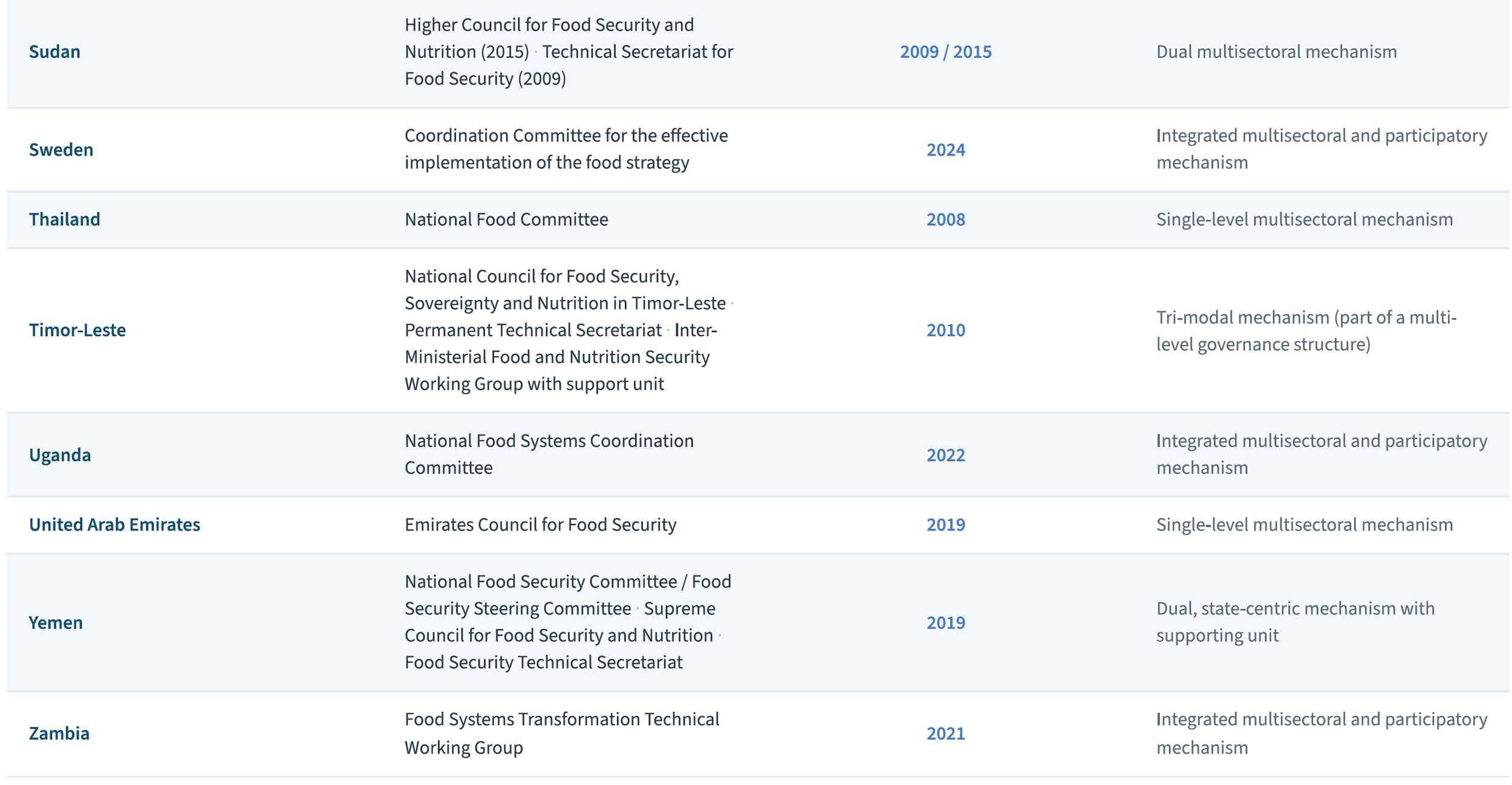
The mechanisms are then distinguished by two features: how their structures connect to one another, and the extent to which non-state actors are involved. Some mechanisms operate with limited or no non-state engagement. A single-level mechanism involves only state actors at one level, whether political or technical, as in Cape Verde's Interministerial Council for the Sustainable Food System. A dual mechanism keeps state actors only, but separates a high-level political body from a mid-level technical one designed to operate together, as in Sudan.
Other mechanisms take participatory approaches, bringing non-state actors into the structure in different ways. An integrated participatory mechanism is a single body that includes both state and non-state actors, as in Nepal's Food System Steering Committee. A dual delineated mechanism uses separate structures to engage state and non-state actors, designed to work together, as in Jordan. A dual participatory mechanism pairs a high-level political body with a mid-level technical one, both including state and non-state actors, as in Gabon. A dual state-centric mechanism combines an integrated multisectoral and participatory body with a second, state-focused body for multisectoral coordination, as in Somalia. A dual stakeholder-centric mechanism does the reverse, pairing an integrated body with a second body dedicated to non-state actor coordination, as in Ecuador. A tri-modal mechanism separates high-level political and mid-level technical bodies while adding a further mid-level structure involving state actors only, as in Brazil's National Food and Nutrition Security System.
Across all these forms, the role of each structure varies between consultative and executive, and ministries retain final executive decision-making authority. The type and depth of non-state involvement also varies considerably from one country to the next.
Understanding the building blocks
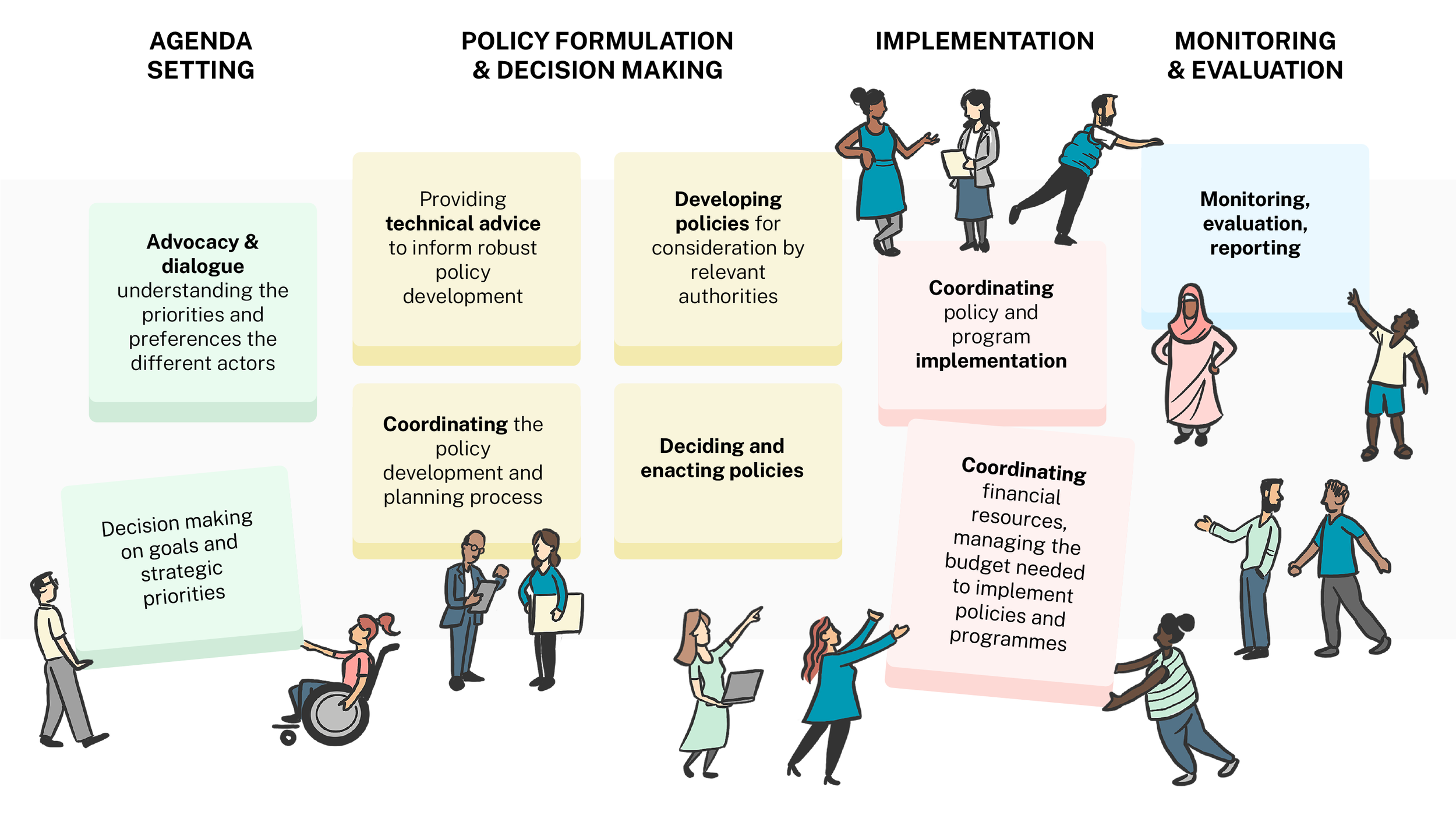
Because there is no single best design, the mapping identifies nine building blocks — the core functions that food system governance institutions are designed to perform. Governments can draw on these to 'custom fit' an institution to their own needs, and to modify, monitor, and evaluate existing structures over time. The building blocks span four areas of activity.
Agenda setting covers advocacy and dialogue — understanding the priorities and preferences of the different actors — and decision making on goals and strategic priorities.
Policy formulation and decision making brings together four functions: providing technical advice to inform robust policy development; coordinating the policy development and planning process; developing policies for consideration by the relevant authorities; and deciding on and enacting those policies.
Implementation covers coordinating policy and programme implementation, and coordinating the financial resources and managing the budget needed to put policies and programmes into practice.
Monitoring and evaluation covers monitoring, evaluation, and reporting.
Importantly, none of the identified institutions performed all nine functions, and an institution is not necessarily stronger for containing more of them, or in any particular combination. A higher number of building blocks increases complexity, and may bring higher administrative costs and a greater need for a strong convening authority to ensure effective implementation. Some governments may therefore opt for more streamlined approaches with fewer functions.
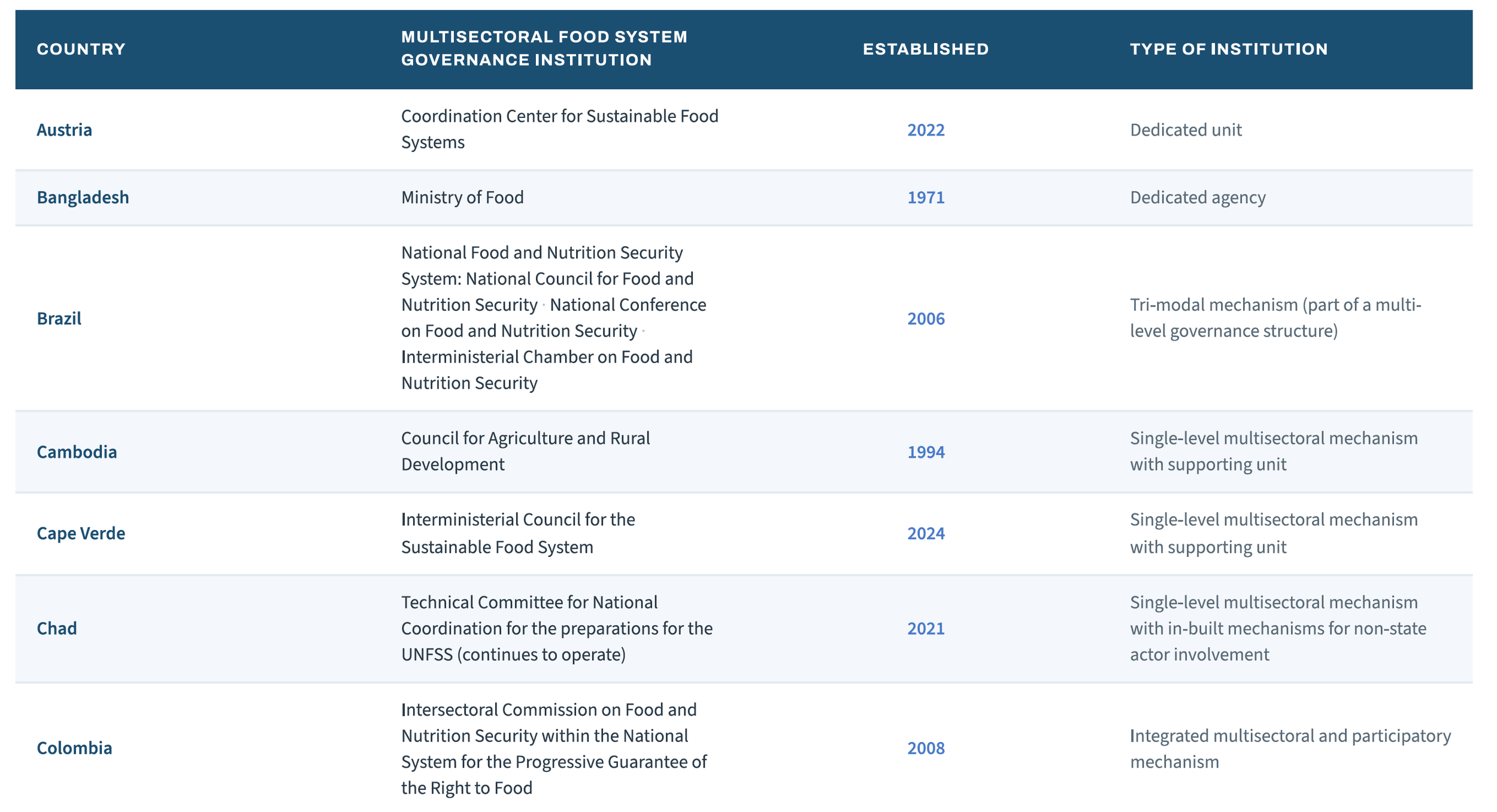
Explore the institutions by country
How institutions were identified
To decide which institutions to include in the mapping, we applied six criteria, each with a corresponding ground for exclusion. Together they define what counts as a national, multisectoral, government-led food system governance institution [1].
To be included, an institution needed to meet all of the following.
It has a permanent structure that facilitates alignment across government agencies and sectors, and steers or monitors how food system priorities and policies are defined and implemented — informal, ad hoc, or temporary arrangements were excluded.
Its stated objectives span multiple, whole-of-food-system outcomes across social (including health), environmental, and economic dimensions; where broad terms such as 'food security' were used, we screened policies, meeting reports, and other records of the institution's operations to understand how those objectives translated into whole-of-food-system outcomes. Institutions focused on a single component or outcome — food waste or product reformulation, for example — or that did not explicitly state objectives across all three dimensions, were excluded.
It operates at the national level, rather than sub-national, regional, or local.
It takes a whole-of-government approach, engaging agencies and policies that govern environmental, social, health, trade, industry, and economic or fiscal matters, rather than a selected few.
It is government-led, rather than led by non-state actors such as UN agencies, civil society, or commercial actors.
It has already been operationalised and is currently in operation, rather than in a planning or preparation phase.
Every institution meeting these criteria was validated by in-country experts before inclusion.
Continue exploring the Framework and its Toolkit
Theory of Change · Assessment Tools · Thinking Tool · Quick Diagnostic Tool · Case Studies & Lessons · Guidance for Development Partners
References
Patay, D., Rippin, H., Ares, G., Reeve, E., Venegas Hargous, C., Farrell, P., Reeve, B., Vivero-Pol, J.L., Thow, A.M. (2025). "From Ministries of Food to National Food System Committees: a global mapping and typology of multisectoral food system governance institutions." Sustainable Development. Download the article
Patay, D., Rippin, H., Ares, G., Reeve, E., Venegas Hargous, C., Farrell, P., Reeve, B., Vivero-Pol, J.L., Thow, A.M. (2025). “A global mapping of multisectoral food system governance institutions.” Policy brief. University of Sydney; Sydney. Download the brief