
All countries
Somalia
The Council for Food Systems, Nutrition and Climate Change
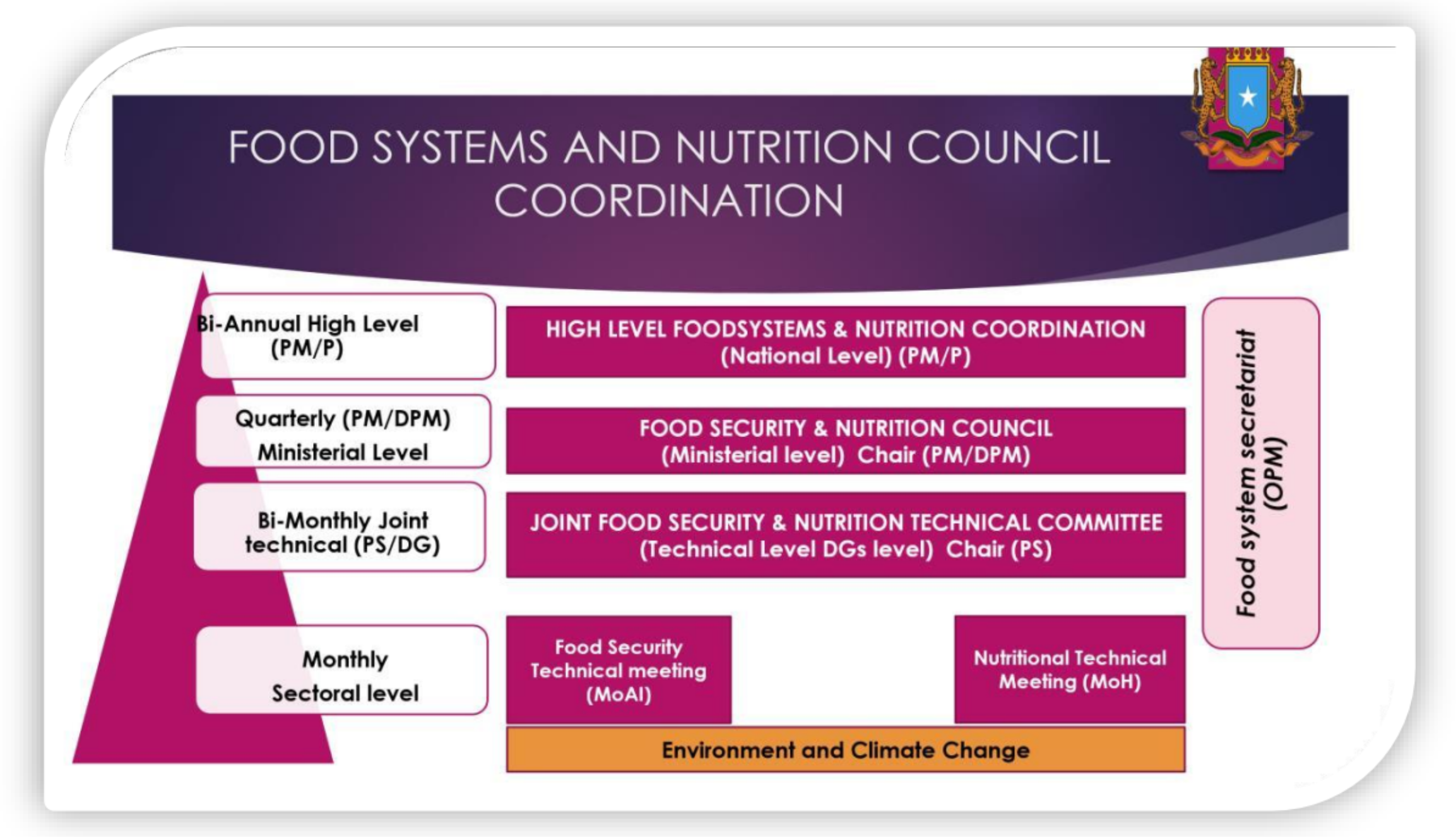
Somalia coordinates food security and nutrition through the Food Security and Nutrition Coordination Council (FSNCC), a high-level inter-ministerial body launched in September 2023. It is convened from the Office of the Prime Minister and chaired by the Deputy Prime Minister, and brings federal ministries together across production, social services and cross-cutting functions, with a designated tier through which implementing partners, civil society and the private sector take part in day-to-day coordination.
Institutional set-up and structure
A single-level multisectoral mechanism established to bring government agencies together around food security and nutrition. Its Secretariat is housed in the Office of the Prime Minister and it is chaired by the Deputy Prime Minister, giving it supra-sectoral convening authority across line ministries. Day-to-day coordination is carried out by the FSNCC Unit within the Office of the Prime Minister and organised through three technical sectors: Food Security, led by the Ministry of Agriculture; Nutrition and WASH, led by the Ministry of Health; and Environment and Climate Change, a cross-cutting sector working closely with the Ministry of Environment. Its Terms of Reference were adopted in principle at its inaugural meeting in August 2023.
Mandate and decision-making power
The Council's mandate is to provide strategic advisory services, expert guidance and recommendations, and to align policies across government ministries. Its Terms of Reference set out seven strategic functions, from leading the response to hunger and malnutrition through to multisectoral advocacy and resource mobilisation, and provide for decisions to be taken at bi-annual high-level meetings. Its architecture is one of coordination, dialogue and convening, strategic priority-setting and oversight, and policy development for others to enact, rather than policy enactment or resource allocation. Members experience its authority as carrying real weight: half of those surveyed described the Council as having binding decision-making authority, and a further fifth identified a strong advisory role — pointing to an opportunity to set out the Council's authority more explicitly as its internal rules are formalised.
The Council is tasked with the following roles (building blocks):
Agenda setting: advocacy and dialogue; decision making on goals and strategic priorities
Policy formulation and decision making: providing technical advice; coordinating the policy development and planning process; developing policies for consideration by relevant authorities
Implementation: coordinating policy and programme implementation (developing)
Monitoring and evaluation: monitoring, evaluation and reporting (developing)
This profile reflects the Council's position as a coordinating and advisory body: strongest at the convening, priority-setting and policy-development ends of the cycle, with enacting decisions and allocating resources resting with member ministries and the Cabinet.
Who is involved
Government: federal ministries chaired by the Deputy Prime Minister, spanning production (Agriculture and Irrigation; Livestock, Forest and Rangeland Management; Water and Energy Resources; Fisheries and Blue Economy), social services (Health and Human Services; Education; Labour and Social Affairs) and cross-cutting functions (Finance; Planning, Investment and Economic Development; Environment and Climate Change)
Development partners: implementing partners are formally represented as members of the three technical sectors
Civil society: civil society organisations are formally represented as members of the three technical sectors
Private sector: formally represented as members of the three technical sectors
Federal Member States: engaged in the Council's work, with formal membership under active discussion among members
How it works in practice
High-level Council meetings bring ministers together, while the three technical sectors meet monthly and form the collaborative tier where state and non-state actors work alongside one another. The Council's influence reaches member ministries through three visible channels. Through joint policy development and alignment, member ministries have embedded cross-sector objectives, indicators and responsibilities in their own sectoral instruments, for example, the Somalia Nutrition Action Plan assigns specific tasks to non-health ministries, including making agricultural policy nutrition-sensitive. Through the National Transformation Plan Labs, the Council helps translate the high-level goals of the Somalia Food Systems Pathways into ministry-level implementation plans with defined responsibilities and budgets. And through a shared "True North" vision, it provides a common reference that ministries cite as the foundation for major strategies. The FSNCC Unit keeps members informed between meetings, prepares briefing materials and agendas, produces technical analysis and follows up on decisions.
Evidence base: Extended Assessment of the Food System Governance Framework, 2026. Last updated: September 2026.
Strengths
A strong institutional foundation: a clearly articulated mission, goals and scope organised through sectoral pillars, convened from the Office of the Prime Minister and chaired by the Deputy Prime Minister — giving the Council clear legitimacy to coordinate across ministries
A tiered design that engages non-state actors effectively: broad and active membership across federal ministries, alongside three technical sectors in which implementing partners, civil society and the private sector participate as members in monthly coordination — allowing government to retain core decision making while broadening participation
Demonstrable change within a short period: members report markedly greater awareness of one another's priorities and closer engagement; a food systems lens and a consensus-based shared vision are now widely held; policy coherence has improved, with cross-sector objectives carried into agriculture, health, environment and fisheries policies; and two multisectoral instruments — the Somalia Nutrition Action Plan and the National Blue Economy Strategy — were adopted during the Council's first years