
THE BASICS
New to food system governance? Let’s start with the basic concepts
What is a food system?
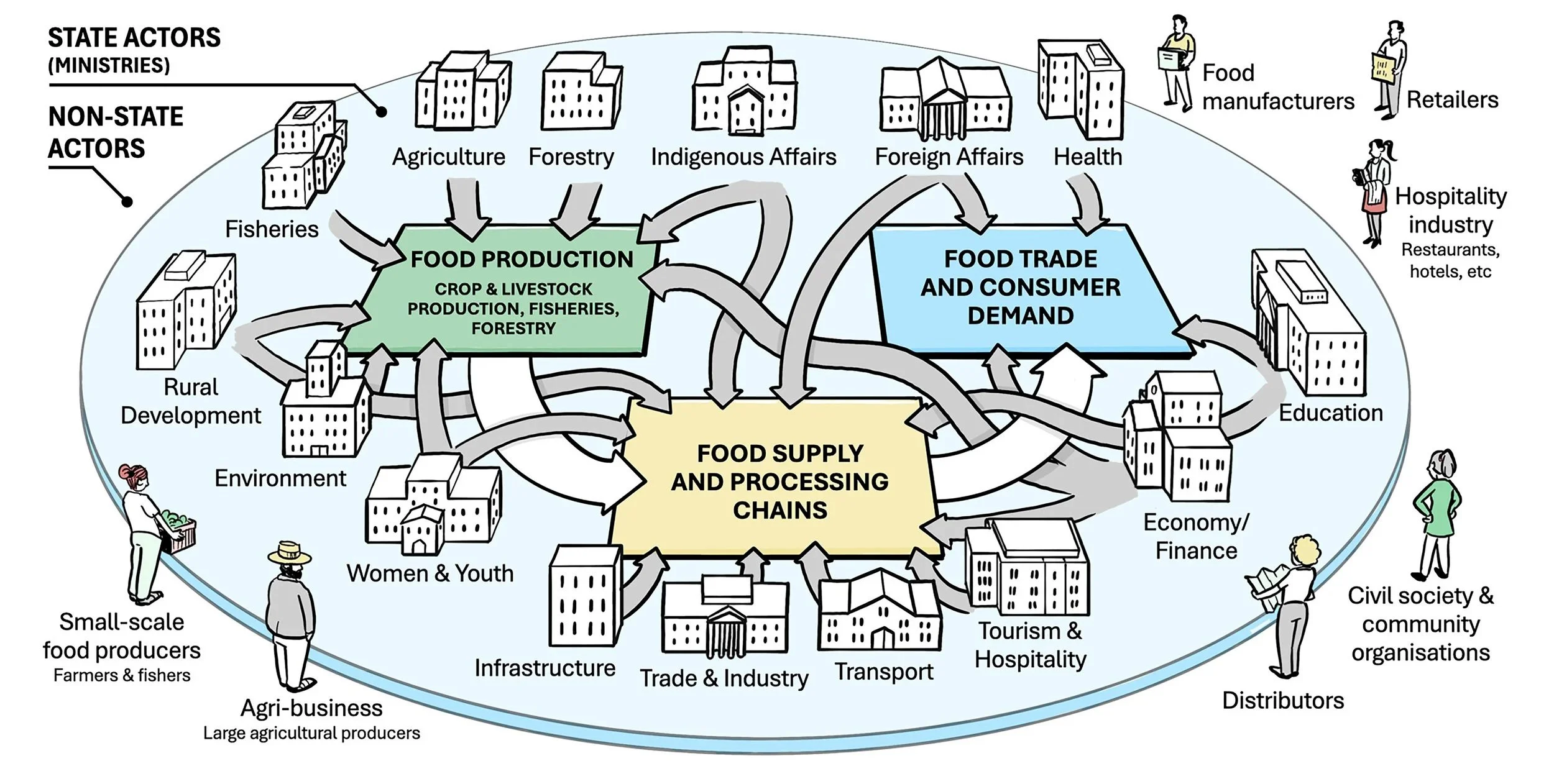
A food system encompasses all the actors, activities, and resources involved in bringing food from production to consumption and disposal — farming, fishing, processing, distribution, trade, retail, eating, and waste — together with the social, environmental, and economic outcomes these generate. It reaches across many sectors (agriculture, health, trade, environment, finance, and more) and many actors, from government ministries to farmers, companies, civil society, and communities [1].
What is food systems governance?
Food system governance is the process through which societies steer their food systems — determining who sets priorities, how power and resources are distributed, and whose interests are heard [2]. It works by negotiating, aligning, and coordinating collective action across the many sectors and the state and non-state actors involved [3].
The UN Food Systems Summit describes it as the tailored process by which societies negotiate, implement, and evaluate the shared priorities of food system transformation, while building a common understanding of the synergies and trade-offs across diverse sectors, scales, and stakeholders [4].
The aim is food systems that deliver on all three fronts together — healthy diets, sustainable livelihoods, and environmental protection — rather than advancing one at another's expense [5]. Countries around the world are converging on the view that reaching all three at once depends, above all, on how food systems are governed [6].
The barrier: governance is where countries get stuck
The hardest barrier is rarely a shortage of policies or technical solutions — it is governance itself. This holds across countries regardless of income or development level [7]. A handful of governance failures recur [2]:
Fragmentation and siloed decision-making. Responsibility is split across many ministries, making it hard to account for the interdependent nature of food systems even when each sector performs well on its own terms.
Conflicting interests and ideas. Food system actors are driven by widely different interests, mandates, values, and ideologies, which makes consolidating a shared agenda demanding.
Power asymmetries. Power is unevenly distributed — between stronger and weaker ministries, and between powerful corporations and less powerful civil society or small-scale producers — so some voices dominate and others go unheard.
Risk of capture. Where powerful commercial actors are given formal roles without safeguards for conflicts of interest, existing imbalances can be entrenched rather than redressed.
Left unaddressed, these failures produce policy incoherence — where the policies of one sector inadvertently undermine another's, wasting resources and worsening outcomes [8]. Improving policy coherence, so that policies across sectors reinforce rather than work against one another, is central to strengthening food systems, and it is one of the clearest signs that governance is working [3,8].
The response: whole-of-government and whole-of-food system institutions
To tackle these challenges, governments are increasingly establishing institutions that coordinate across the food system. Three related ideas define what these institutions do [3,9]:
Multisectoral governance: government agencies from different policy sectors working together, rather than any single sector acting alone.
Whole-of-government approach to food system governance: a multisectoral, intra-government approach that brings together all the government agencies whose mandates touch the food system and coordinates across them. Whole-of-government institutions coordinate government agencies only.
Whole-of-food system governance: combines the whole-of-government approach with a government-led participatory approach that also formally engages non-state actors — civil society, commercial and market actors, academia, and development partners — across the entire food supply chain. It aligns thinking and action across all sectors and actors, from production to consumption and disposal, to improve policy coherence, balance competing interests, and address power asymmetries.
In short: a whole-of-government institution coordinates government agencies; a whole-of-food-system institution also formally brings non-state actors to the table.
Where the Framework comes in
The Food System Governance Strengthening Framework picks up from here: it sets out how a whole-of-government, whole-of-food system institution creates change, and how to assess and strengthen one.
References:
HLPE (2017). Nutrition and food systems. A report by the High Level Panel of Experts on Food Security and Nutrition of the Committee on World Food Security. Rome, High Level Panel of Experts (HLPE) on Food Security and Nutrition of the Committee on World Food Security: 152.
Patay, D., Reeve, E., Thow, A.M., Baker, P., Farrell, P. (2025). Whole-of-food system governance for transformative change. Nature Food, 6(7), 636–640. doi:10.1038/s43016-025-01196-x.
FAO (2025). Transforming food and agriculture through a systems approach. Rome, Italy, Food and Agriculture Organization of the United Nations (FAO).
UN Food Systems Summit. Policy Brief: Governance of Food Systems Transformation. New York: United Nations; 2021. unfoodsystemshub.org/docs/unfoodsystemslibraries/fss-community/chapter-2/policybrief_governanceunfss.pdf
Fanzo, J., et al. (2022). "Sustainable food systems and nutrition in the 21st century: a report from the 22nd annual Harvard Nutrition Obesity Symposium." Am J Clin Nutr 115(1): 18-33.
UN Food Systems Hub (2025). UN Food Systems Summit +4 Stocktake Report of the Secretary-General: Accelerating Inclusive, Resilient and Sustainable Food Systems Transitions for People and Planet. https://www.unfoodsystemshub.org/media/docs/unfoodsystemslibraries/unfss-4/unfss4_en_sg_report.pdf?sfvrsn=6058e01b_1
Schneider, K. R., et al. (2025). "Governance and resilience as entry points for transforming food systems in the countdown to 2030." Nature Food 6(1): 105-116.
FAO (2026). Advancing policy coherence for agrifood systems transformation. Emerging lessons from ten countries. Rome, Food and Agricultural Organization of the United Nations (FAO). https://doi.org/10.4060/ce0124en
Patay, D., Rippin, H., Ares, G., Reeve, E., Venegas Hargous, C., Farrell, P., Reeve, B., Vivero-Pol, J.L., Thow, A.M. (2025). From Ministries of Food to National Food System Committees: a global mapping and typology of multisectoral food system governance institutions. Sustainable Development, 1–21. doi:10.1002/sd.70320