
THE THEORY OF CHANGE
The pathways through which multisectoral food system governance institutions achieve systemic changes
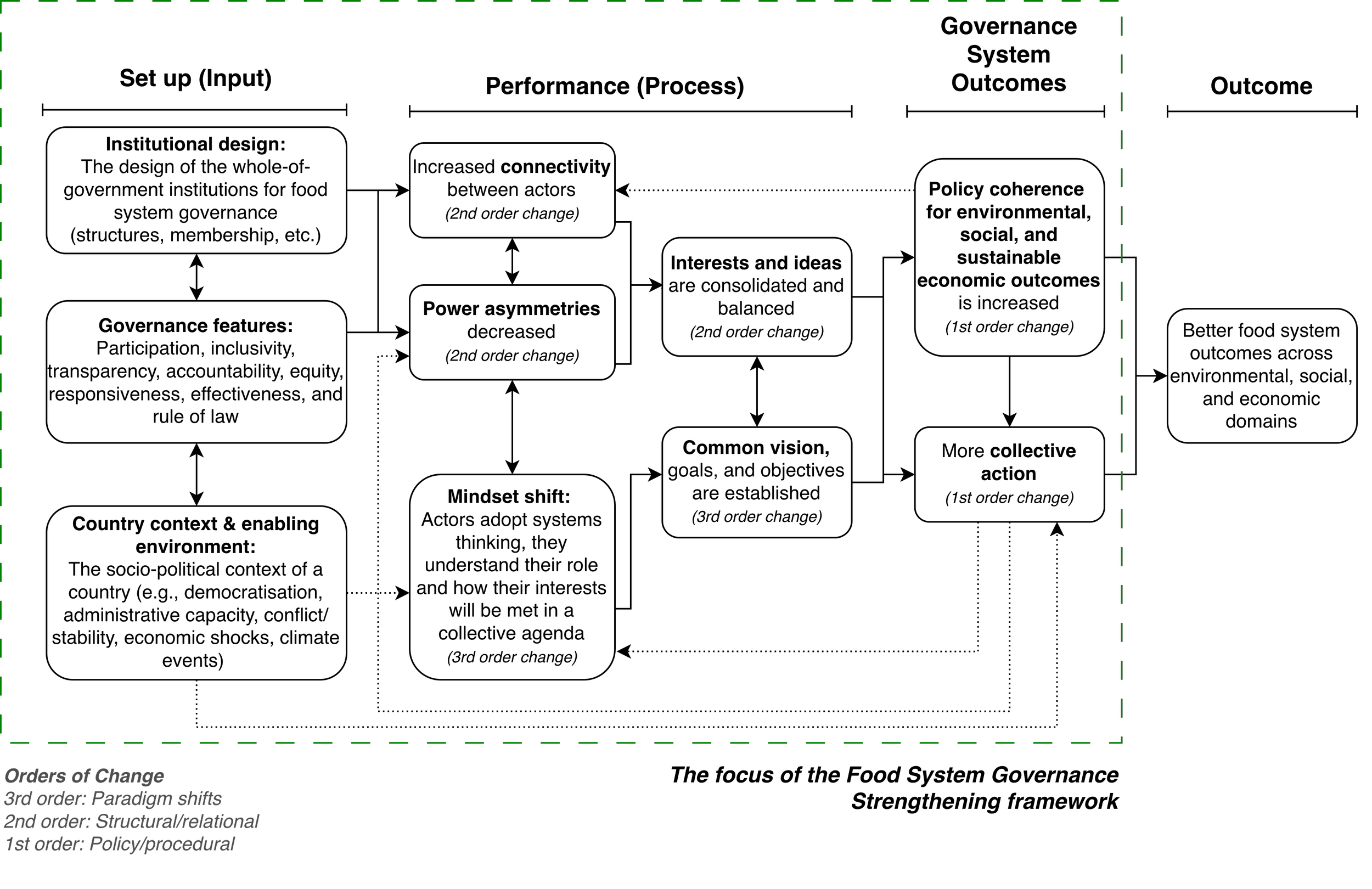
Food system governance plays out in a highly complex socio-political system — many actors with competing interests and ideas, set within an array of institutional structures. Because change in such systems unfolds through non-linear cycles of learning, adjustment, and reinforcement rather than a single forward path, the Framework uses a logic model to trace how change occurs. Rather than asking only whether food system outcomes have changed, it asks: as a result of this institution, what happened, how, why, and so what?
A systems thinking approach
The Food System Governance Strengthening Framework treats the food system as a complex adaptive system with its own actors, rules, feedback loops, and leverage points. Drawing on the Order of Change framework, it distinguishes three depths of change:
First-order change: surface-level adjustments that leave underlying dynamics intact, such as introducing a stakeholder-consultation requirement.
Second-order change: structural shifts that alter how actors connect and engage, such as adopting multisectoral policy frameworks.
Third-order change: fundamental shifts in actors' mindsets, values, and relationships: a paradigm shift in how they think food systems should work and who should steer them.
The central proposition is that resolving the deep-seated challenges of food system governance calls for a combination of third- and second-order change, with first-order changes then following naturally. Because these depths differ in kind, capturing them requires both objective indicators, which track formal and structural change, and subjective indicators, which reveal shifts in relationships and mindsets.
The pathways of change
Institutional Set-up
Three things shape an institution's potential before it does anything at all.
Design: its structures and membership, mission, mandate and functions, convening authority, and decision-making power. Institutions vary widely: some bring together state actors alone, while others formally include non-state actors from civil society, academia, development partners, and the private sector; some serve an advisory function, while others are empowered to make policy decisions. These differences shape what an institution can realistically achieve.
Alignment with good governance principles: participation and inclusivity, equity, responsiveness, accountability, transparency, effectiveness, and the rule of law. The degree to which an institution embodies these principles is a key determinant of whether it performs well and achieves the changes it seeks; procedural equity, in particular, means attending to power asymmetries when deciding which actors are engaged and how much decision-making power they hold.
Country context: administrative capacity, the political settlement, and the capability of non-state actors to engage meaningfully, together with shocks such as conflict, economic crises, pandemics, or climate events that can constrain governance or, at times, catalyse mindset shifts and collective action.
Impacts on Relationships (Performance/Process)
A well-functioning institution moves through a linked sequence of shifts.
Connectivity: it increases connection between actors, breaking down siloed decision-making and improving information flow, transparency, and accountability, so that the priorities and actions of any one ministry become visible to others and synergies and conflicts can be identified.
Reducing power asymmetries: to turn connectivity into a fairer balance of interests, the institution works to ensure that more powerful ministries or non-state actors do not dominate, empowering traditionally less influential actors across state and non-state spaces through structures and procedures that all parties accept and trust.
Mindset shift and shared vision: as actors adopt systems thinking, or a food system lens, they come to understand why they need to work together, agree common goals, and align their thinking around a shared vision.
Balancing interests and ideas: on this foundation, diverse and sometimes conflicting interests and ideas can be consolidated and balanced, with the institution remaining responsive to the differing needs of the actors it convenes.
Impacts on Policies and Implementations (Governance System Outcomes)
Where performance is strong, two outcomes follow.
Improved policy coherence: policies across environmental, social, and sustainable economic domains are aligned, in both planning and implementation, so that they reinforce rather than undermine one another.
Increased collective action: actors work together on areas of synergy, translating a shared vision into joint effort across sectors.
Food system outcomes
Better governance is, in turn, assumed to feed through to social, environmental, and economic outcomes. The causal chain here is long and shaped by many other factors, so the Framework concentrates on the links it can credibly evaluate — from an institution's set-up and performance to its governance-system outcomes — while leaving the measurement of food system outcomes to the many frameworks already designed for that purpose.
Continue exploring the Toolkit
Global Map & Typology · Assessment Tools · Thinking Tool · Quick Diagnostic Tool · Case Studies & Lessons · Guidance for Development Partners