
All countries
Yemen
The Supreme Council for Food Security and Nutrition, the Steering Committee for Food Security, Food Security Technical Secretariat, Scaling Up Nutrition (SUN) Steering Committee and Secretariat, and the National Committee for Food Safety
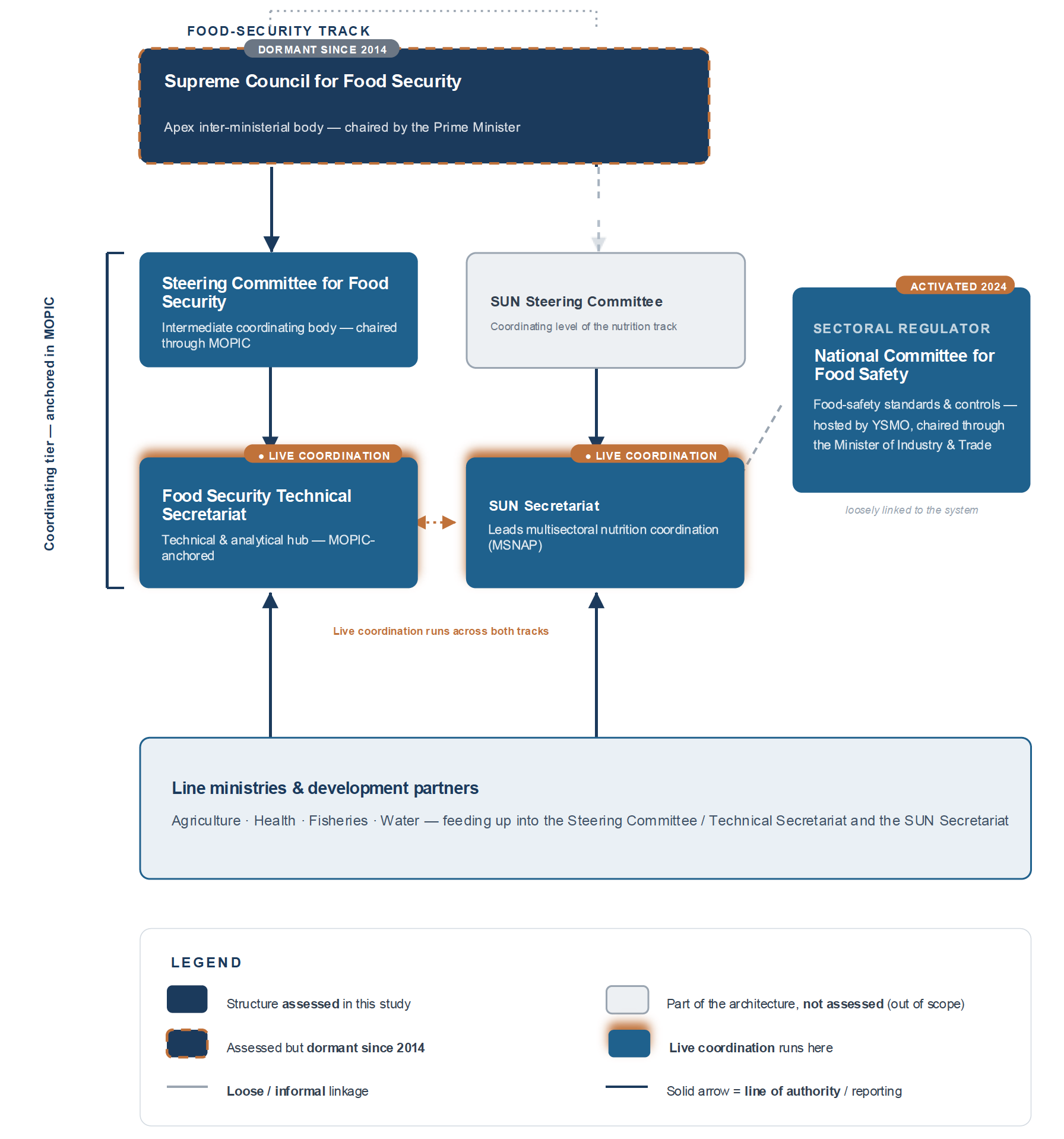
Yemen's food security governance is designed as a three-tier architecture anchored in the Ministry of Planning and International Cooperation: the Supreme Council for Food Security at the highest political level, chaired by the Prime Minister; the Steering Committee for Food Security as the intermediate coordinating body; and the Food Security Technical Secretariat as its analytical engine. Alongside these, the Scaling Up Nutrition (SUN) Secretariat leads multisectoral nutrition coordination, and the National Committee for Food Safety serves as the sectoral regulator for food safety standards. Yemen's National Food Systems Transformation Pathways have been formally endorsed by the Council of Ministers, and these structures carry primary responsibility for implementing them.
Supreme Council for Food Security
Institutional set-up and structure. Established by Cabinet Resolution 109 of 2013 and operationalised in 2014 through an inter-ministerial process led by the Ministry of Planning and International Cooperation and the Ministry of Agriculture, Irrigation and Fisheries Wealth. It is convened and chaired by the Prime Minister and sits at the highest political level of the architecture. The Council has not convened since 2014, a period coinciding with the wider erosion of state capacity from that year onwards rather than reflecting anything in its own design.
Mandate and decision-making power. The founding decree and the National Agriculture and Fisheries Strategy and Investment Plan define the Council as the high-level, inter-ministerial political decision-making body: the locus for approving multisectoral policies, managing strategic food reserves and leading crisis response. It holds formal power to make political decisions, approve projects and frameworks, establish regulations and direct emergency responses — the only body in the architecture with decision-making authority of this kind, qualified by the requirement that certain decisions be referred to the Council of Ministers. Its mandate sets unambiguous objectives, including maintaining a three-to-six-month strategic food reserve and acting as the political locus for resource mobilisation. Its scope covers food security, without a nutrition counterpart at this level.
The Council is tasked with the following roles (building blocks):
Agenda setting: advocacy and dialogue; decision making on goals and strategic priorities
Policy formulation and decision making: deciding on and enacting policies
Implementation: coordinating policy and programme implementation; coordinating financial resources
Who is involved. Convened and chaired by the Prime Minister, with documented supra-sectoral reach across more than a dozen ministries, funds and peak private-sector associations.
How it works in practice. The Council is designed to receive recommendations from the Steering Committee and convert them into political decisions. With no meetings since 2014, the Steering Committee's recommendations currently have no functioning Supreme Council to enact them, and live coordination runs through the Technical Secretariat and the SUN Secretariat instead.
Steering Committee for Food Security
ItInstitutional set-up and structure. The intermediate coordinating tier of the architecture, established by Cabinet Resolution 109 of 2013 and convened and chaired through the Ministry of Planning and International Cooperation. It operates as the supervisory body over the Food Security Technical Secretariat.
Mandate and decision-making power. The Committee supervises technical preparation, sets agendas against the national strategy, and raises draft resolutions and recommendations to the Supreme Council, which the founding documents identify as the decision-making locus. Its mandate and goals are clearly articulated and highly specific in both the 2013 decree and subsequent strategy documents, with well-defined scope and boundaries within the institutional hierarchy. Its role is advisory, preparatory and supervisory: members describe a strong advisory role whose guidance ministries usually follow, with enactment depending on the tier above.
The Committee is tasked with the following roles (building blocks):
Agenda setting: advocacy and dialogue; decision making on goals and strategic priorities
Policy formulation and decision making: providing technical advice; coordinating the policy development and planning process; developing policies for consideration by relevant authorities
Monitoring and evaluation: supervision and oversight of the Technical Secretariat's work
Who is involved
Government: chaired through the Ministry of Planning and International Cooperation, with documented coordination of line ministries including Agriculture, Irrigation and Fisheries Wealth, Industry and Trade, Public Health and Population, and Finance. All respondents report that ministry and agency representatives take part actively, with none describing passive attendance
Non-state actors: civil society, the private sector and development partners participate, with engagement less consistent than on the government side and the intended role of each group an area the Committee may wish to clarify
How it works in practice. The Committee convenes to validate technical work and ratify policy proposals, setting its agenda against the national strategy and directing the Technical Secretariat's programme. Its minutes record genuine deliberation, including dissent, objection and redrafting. Documentary evidence shows it accomplishing most of its stated objectives and supervising a Secretariat whose activity-implementation rates exceeded 99 per cent across 2022–2024, while its own self-evaluation notes that it periodically requires reactivation and that broader policy goals stall when the Supreme Council does not convene.
Food Security Technical Secretariat
Institutional set-up and structure. The analytical engine of the three-tier structure, established within and convened by the Ministry of Planning and International Cooperation, operating under the supervision of the Steering Committee and, in design, the Supreme Council.
Mandate and decision-making power. Founding decrees, ministerial decisions and strategic Letters of Agreement define the Secretariat's goals, scope and boundaries through an extensive, legally codified list of duties spanning data collection, early warning, capacity building and policy briefing. It is a technical and advisory body: it supplies information, analysis and recommendations to the tiers above rather than taking binding decisions, so its influence runs through the quality of its analysis and whether that analysis reaches decision makers.
The Technical Secretariat is tasked with the following roles (building blocks):
Agenda setting: advocacy and dialogue
Policy formulation and decision making: providing technical advice
Monitoring and evaluation: monitoring, evaluation and reporting
Who is involved
Government: convened through the Ministry of Planning and International Cooperation, with documented supra-sectoral reach spanning agriculture, health, trade, finance and environment; all respondents report active participation by ministry representatives
Non-state actors: civil society, the private sector, UN agencies and development partners participate, with most respondents reporting active engagement and none reporting token involvement
Sub-national: governorate field units contribute to data collection
How it works in practice. The Secretariat produces the data, early warning products, reports and evidence syntheses on which coordination across the architecture depends, and leads implementation of the Integrated Food Security Phase Classification in Yemen. It provides continuous training for members in data collection and analysis, food security concepts and analytical frameworks. It rigorously tracks its own objectives and delivers close to 100 per cent of planned outputs, with members attributing any shortfall to external funding gaps and government-level delays rather than to its own functioning.
SUN Secretariat
Institutional set-up and structure. Leads multisectoral nutrition coordination, housed within and convened by the Ministry of Planning and International Cooperation, and operating under the supervision and guidance of the National SUN Steering Committee. It derives from the global Scaling Up Nutrition movement rather than from Cabinet Resolution 109 of 2013, and runs in parallel to the food security track.
Mandate and decision-making power. Its mission, purpose and goals are clearly and specifically articulated across its terms of reference and strategic guidelines, drawing a firm boundary between its technical and administrative functions and the political processes above it, and translating overarching goals into actionable tasks — updating the Multisectoral Nutrition Action Plan, preparing biannual reports and managing the Nutrition Information Platform. Decisions on plans and budgets rest with the government-led Steering Committee, with the Secretariat holding facilitation, coordination and guidance functions. A prime-ministerial decree or legal mandate matching its coordinating responsibilities is the most consistent request from its stakeholders.
The SUN Secretariat is tasked with the following roles (building blocks):
Agenda setting: advocacy and dialogue
Policy formulation and decision making: providing technical advice; coordinating the policy development and planning process
Implementation: coordinating policy and programme implementation
Monitoring and evaluation: monitoring, evaluation and reporting
Who is involved
Government: line ministries convened through the Ministry of Planning and International Cooperation, which co-chairs sector working groups across health, agriculture, education and water at national and sub-national levels; around four in five respondents report that all or most ministry representatives participate actively and meaningfully
Development partners: convened alongside line ministries around the Multisectoral Nutrition Action Plan
Civil society and private sector: 86 per cent of respondents report that all or most non-state actors participate meaningfully
Sector Working Groups: give line ministries and non-state actors a structured place in nutrition coordination
How it works in practice. The Secretariat convenes line ministries and development partners around the Multisectoral Nutrition Action Plan, which it has updated together with its monitoring, evaluation, accountability and learning framework and its advocacy framework. It has revitalised the SUN Steering Committee and technical teams, manages the Nutrition Information Platform, prepares biannual reports, and has begun piloting sub-national structures in Taiz and Lahj. Nearly four in five members rate the organisation of its meetings, communication and follow-up as effective or very effective.
Evidence base: Extended Assessment of the Food System Governance Strengthening Framework (documentary evidence and stakeholder surveys), 2026.
Last updated: September 2026.
National Committee for Food Safety
Institutional set-up and structure. A sectoral regulator for food safety standards and controls, established by decree in 2010 and reaffirmed in 2025, hosted by the Yemen Standardization, Metrology and Quality Control Organization, whose administration acts as its secretariat. It is chaired through the Minister of Industry and Trade. Its members were named and its first meeting held in 2024, so its results describe an institution beginning to function rather than sustained performance.
Mandate and decision-making power. Its founding decree sets out a mission and 23 detailed goals, defining an advisory, coordinating and Codex-aligned purpose. Its recommendations require ratification by the Minister of Industry and Trade, with member ministries obliged to cooperate and share data. Members hold differing views on whether the Committee advises or decides, and clarifying this in an updated instrument, alongside member-agency responsibilities, is identified as a foundational step.
The Committee is tasked with the following roles (building blocks):
Agenda setting: advocacy and dialogue on food safety standards
Policy formulation and decision making: providing technical advice; developing standards and recommendations for ratification by the responsible minister
Who is involved
Government: chaired through the Ministry of Industry and Trade and hosted by the Yemen Standardization, Metrology and Quality Control Organization, with food safety responsibilities also falling under the Ministry of Public Health and Population, and the Ministry of Planning and International Cooperation participating as a member
Non-state actors: civil society, the private sector and development partners are present, with involvement described as modest and inconsistent at this early stage
How it works in practice. The Committee issues recommendations that are channelled and ratified through the Ministry of Industry and Trade, with the Standardization Organization hosting meetings, providing the secretariat function and controlling its budget. Beyond its formal links, food safety actors have engaged with the SUN Steering Committee and the Health Sectoral Working Group since 2015, and the Committee's formal inclusion in an updated Steering Committee membership is being finalised with SUN support.