
All countries
Timor-Leste
National Council for Food Security, Sovereignty and Nutrition (CONSSAN-TL)
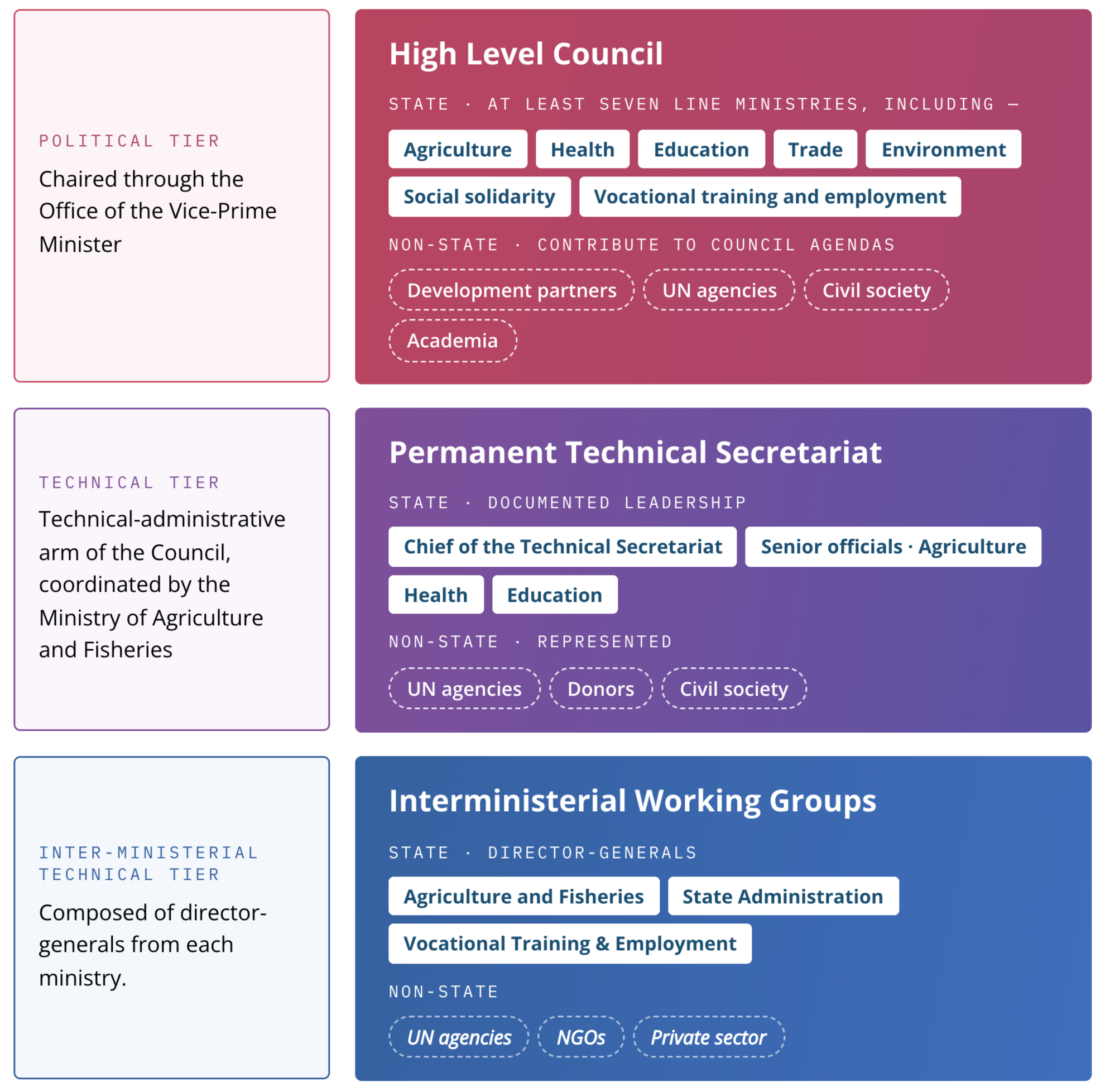
Timor-Leste governs food security, sovereignty and nutrition through a three-tier architecture under the National Council for Food Security, Sovereignty and Nutrition (CONSSAN-TL), placed on a renewed legal footing by Decree-Law No. 9/2024. The High Level Council sits at the highest political level, chaired through the Office of the Vice-Prime Minister, and provides the formal endorsement through which multisectoral plans are adopted. The Permanent Technical Secretariat is its technical-administrative arm, preparing and coordinating the Council's decisions. The Interministerial Working Groups, composed of director-generals from each ministry, are the technical forum in which sectoral mandates are reconciled before political endorsement. The architecture operates broadly as designed, with strategic direction cascading from the Council through the Secretariat to the Working Groups.
High Level Council of CONSSAN-TL
Institutional set-up and structure. The National Council itself, and the highest tier of the architecture. Convening authority was formally elevated from the Ministry of Agriculture to the Office of the Vice-Prime Minister, giving the Council supra-sectoral standing to coordinate at least seven line ministries. Its legal foundation is Chapter III, article 9, point 2 of Decree-Law No. 9/2024.
Mandate and decision-making power. Decree-Law No. 9/2024 defines the Council as the primary inter-ministerial body for coordinating and evaluating food sovereignty and nutrition policy, with measurable goals set out in the National Multisector Nutrition Action Plan 2024–2030. Roles and responsibilities are formally defined and operationalised through the Action Plan's Terms of Reference and costed Implementation Matrix, which assign accountability and reporting duties to individual ministries. The Council is the standing mechanism through which ministerial agreement becomes formal approval, and it holds documented standing to issue directives. What the founding decree implies for binding as against advisory authority is understood differently by different members, and clarifying this is identified as an early opportunity.
The Council is tasked with the following roles (building blocks):
Agenda setting: advocacy and dialogue; decision making on goals and strategic priorities
Policy formulation and decision making: developing policies for consideration by relevant authorities; deciding on and enacting policies, through its formal endorsement mandate
Implementation: coordinating policy and programme implementation (developing)
Monitoring and evaluation: monitoring, evaluation and reporting
Who is involved
Government: at least seven line ministries, convened through the Office of the Vice-Prime Minister, with a majority of members reporting that all state representatives participate actively and meaningfully
Non-state actors: participate in the Council's work, with the extent of engagement varying and no documented mechanism currently defining non-state roles or participation rights
Development partners: prominent among non-state participants across the architecture
How it works in practice. The Council sets strategic direction, which is seen to cascade strongly to the Permanent Technical Secretariat and onward to the Interministerial Working Groups. It has delivered three strategic frameworks and elevated nutrition to the Vice-Prime Minister's office. Multiple multisectoral plans have been adopted through its endorsement mandate, including the National Food and Nutrition Security Policy (2017), PAN-HAM-TIL (2014), the Consolidated National Action Plan for Nutrition and Food Security (2020), and the National Multisector Nutrition Action Plan 2024–2030. Resourcing is drawn from both the State budget and development partners' allocations for coordination activities.
Permanent Technical Secretariat of CONSSAN-TL
Institutional set-up and structure. The technical-administrative arm of CONSSAN-TL, which coordinates and prepares the Council's decisions. It is led by senior officials from Agriculture, Health and Education and includes government, UN, donor and civil society representation. It serves the High Level Council and reports to it functionally, while being administratively housed within the Ministry of Agriculture and Fisheries. Its formal statutes remain in draft, without a finalised institutional and budgetary home.
Mandate and decision-making power. The Secretariat's mandate, set out across the architecture's structural documents, is to advocate, coordinate and monitor multisectoral action, with its technical and administrative function cleanly distinguished from high-level decision making. Its authority is advisory: it formulates recommendations for the Council to consider, and its influence runs through the quality of that preparation and through whether its technical work reaches and shapes decisions at the political tier.
The Technical Secretariat is tasked with the following roles (building blocks):
Agenda setting: advocacy and dialogue
Policy formulation and decision making: providing technical advice; coordinating the policy development and planning process
Implementation: coordinating policy and programme implementation
Monitoring and evaluation: monitoring, evaluation and reporting (mandated; framework not yet established)
Who is involved
Government: senior officials from Agriculture, Health and Education, with 83 per cent of members reporting that all government representatives participate actively — the strongest and most consistent participation result in the assessment
Development partners: UN agencies and donors represented as members
Civil society: represented as members, with two-thirds of respondents reporting that all non-state actors participate actively and none reporting exclusion
How it works in practice. The Secretariat reliably organises working groups, roundtables and dialogue sessions, and prepares the material on which Council decisions rest. It receives strategic direction from the Council and passes it to the Interministerial Working Groups, with technical exchange between the Secretariat and the Working Groups broadly reciprocal. Its technical work is seen to inform Council decisions moderately, making the upward flow of evidence to the political tier the point in the architecture with most room to develop.
Interministerial Working Groups of CONSSAN-TL
Institutional set-up and structure. The technical forum in which sectoral mandates are reconciled before political endorsement. Composed of director-generals from each ministry and convened by the Office of the Vice-Prime Minister, with Terms of Reference mandating the focal point to circulate agendas and chair sessions. The Groups work through thematic sub-groups.
Mandate and decision-making power. Decree-Law No. 9/2024 defines the Working Groups' competencies as proposing plans and formulating recommendations. Their authority is advisory, and their distinctive contribution is integration: they are the engine through which cross-sectoral integration is forged, balancing competing sectoral claims and building common purpose before matters reach the political tier. Members hold differing views on whether their decisions bind, and clarifying the legal basis is identified as an opportunity.
The Technical Secretariat is tasked with the following roles (building blocks):
Agenda setting: advocacy and dialogue
Policy formulation and decision making: providing technical advice; coordinating the policy development and planning process; developing policies for consideration by relevant authorities
Implementation: coordinating policy and programme implementation (prospective)
Who is involved
Government: director-generals from each ministry, with two-thirds of members describing state participation as active or very active, and some variation across ministries and meetings
Non-state actors: no documented mechanism currently defines non-state roles or participation rights at this tier
How it works in practice. The Working Groups receive direction from the Permanent Technical Secretariat and reconcile sectoral mandates at technical level, producing the integrated plans that the High Level Council then formally endorses. Technical exchange with the Secretariat is broadly reciprocal. The Groups continue to convene and coordinate across their thematic sub-groups, and their own 2025 reporting identifies a need to regularise meetings.
Evidence base: Extended Assessment of the Food System Governance Strengthening Framework (documentary evidence and stakeholder surveys), 2026. Last updated: September 2026.